

/anastasios-antoniadis-AMXFr97d00c-unsplash.jpg?width=300&name=anastasios-antoniadis-AMXFr97d00c-unsplash.jpg)
A guide to the standards shaping sustainability disclosure across APAC
In this article
Sustainability reporting now comes with a growing list of acronyms for many maritime companies: ISSB, IFRS S1, IFRS S2, SASB, GRI, TCFD and more.
Across the maritime sector, ESG reporting is no longer relevant only to companies with formal listing obligations. Listed companies may face direct expectations from exchanges and investors, while non-listed companies can still be affected through financing discussions, customer requirements, tenders, group-level reporting and supply chain assessments.
For shipowners, operators, shipbuilders, offshore service providers, port-related businesses and maritime logistics groups, these standards are more than technical reporting language. They are part of a wider shift towards sustainability disclosure that is more structured, comparable and connected to business performance.
This matters because maritime ESG reporting is highly operational. Relevant data may come from vessels, fuel records, voyage activity, shipyards, crewing, procurement, QHSE, finance, subsidiaries, suppliers and regional offices.
This article explains four key terms maritime companies should know; ISSB, IFRS S1, IFRS S2 and SASB, and how they relate to ESG reporting and data management.
Why these acronyms matter now
Across APAC, sustainability disclosure is becoming more formalised.
Stock exchanges, regulators, investors and lenders are increasingly asking listed companies for sustainability information that is clearer, more consistent and more useful for decision-making. For maritime companies, this can include information related to emissions, fuel consumption, fleet efficiency, climate risks, safety, workforce practices, supply chain responsibility and governance.
Even when a company is not directly required to report under a specific framework, understanding the language of these standards can help teams respond more confidently to ESG information requests.
The growing use of ISSB-aligned disclosure reflects a wider move towards comparability. Investors and other stakeholders want to understand not only what a company reports, but how sustainability issues may affect its financial performance, strategy, risk exposure and long-term value.
/pexels-lifephotographer-15859060.jpg?width=600&height=400&name=pexels-lifephotographer-15859060.jpg)
For maritime companies, this is especially relevant. Carbon taxes, decarbonisation, changing fuel choices, vessel efficiency, safety performance, regulatory pressure, customer expectations and capital investment decisions are all closely connected to sustainability.
Understanding the acronyms is therefore not just about reporting compliance. It is about understanding the language that capital markets and stakeholders increasingly use to evaluate business resilience.
What is ISSB?
ISSB stands for the International Sustainability Standards Board.
It was established under the IFRS Foundation to develop a global baseline for sustainability-related financial disclosures. The aim is to help companies provide sustainability information that is useful to investors and other capital market participants.
In simple terms, ISSB standards help companies explain how sustainability-related risks and opportunities may affect their business.
For maritime companies, this may include questions such as:
- How could climate-related regulation affect fleet operating costs?
- How prepared is the company for fuel transition and decarbonisation?
- How does vessel efficiency affect competitiveness?
- How are sustainability risks considered in strategy and capital planning?
- How does the company manage safety, workforce, environmental and governance risks?
ISSB does not replace every local exchange requirement. Instead, it provides a global baseline that jurisdictions and exchanges can use, adopt or align with in different ways.
What is IFRS S1?
/IFRS%20guideline%20cover.png?width=650&height=459&name=IFRS%20guideline%20cover.png)
IFRS S1 is the ISSB’s general sustainability disclosure standard.
It sets out how companies should disclose sustainability-related risks and opportunities that could reasonably be expected to affect their prospects. These disclosures are structured around areas such as governance, strategy, risk management, metrics and targets.
For a listed maritime company, IFRS S1 is relevant because sustainability issues are often directly connected to business performance.
For example, a shipowner may need to consider how fuel efficiency, emissions performance, vessel age, alternative fuel readiness or customer decarbonisation expectations could affect commercial competitiveness. A shipbuilder may need to consider how environmental performance, worker safety, energy use, supply chain practices and low-carbon vessel demand affect its future business opportunities.
IFRS S1 encourages companies to connect sustainability topics to business context, rather than treating ESG reporting as a separate communication exercise.
What is IFRS S2?
IFRS S2 focuses specifically on climate-related disclosures.
It asks companies to disclose information about climate-related risks and opportunities, including how these are governed, managed, measured and reflected in strategy. This can include greenhouse gas emissions, climate-related targets, transition planning, resilience and climate-related financial effects.
For maritime companies, IFRS S2 is especially important because climate and emissions are closely tied to operations.
Maritime businesses may need to manage and report data related to:
- fuel consumption
- Scope 1 greenhouse gas emissions from owned or operated assets
- energy efficiency
- vessel utilisation and performance
- decarbonisation initiatives
- alternative fuels or technology investments
- climate-related transition risks
- physical risks affecting assets, routes, ports or operations
In practice, this means climate reporting is not only a sustainability team responsibility. It often requires input from fleet operations, technical teams, finance, procurement, QHSE, risk management and senior leadership.
Where SASB fits in
SASB stands for Sustainability Accounting Standards Board.
SASB Standards are industry-specific standards that help companies identify sustainability topics and metrics that may be financially material within their sector. The ISSB builds on existing investor-focused reporting initiatives, including industry-based SASB Standards.
This is important because ESG reporting should not be one-size-fits-all.
The sustainability topics that matter to a maritime company may be very different from those that matter to a bank, software company or property developer. For example, maritime companies may need to focus more heavily on fuel use, emissions, ecological impacts, safety management, labour practices, vessel incidents, supply chain responsibility and operational efficiency.
SASB includes industry guidance for sectors including Marine Transportation. This can help maritime companies identify more relevant disclosure topics and metrics, instead of relying only on broad ESG categories.
For listed maritime companies, SASB can be useful because it connects sustainability topics more closely to operational realities and financial relevance.
How ISSB, IFRS S1, IFRS S2, and SASB work together
These acronyms can feel confusing, but they are connected.
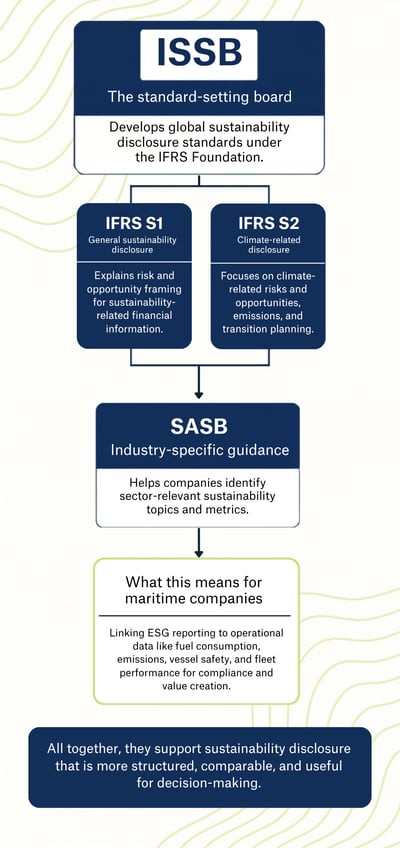 ISSB is the standard-setting board.
IFRS S1 is the general sustainability disclosure standard.
IFRS S2 is the climate-specific disclosure standard.
SASB provides industry-specific guidance and metrics that can help companies identify relevant sustainability topics.
For maritime companies, a simple way to understand the relationship is this:
1. IFRS S1 helps frame the overall sustainability-related risks and opportunities affecting the business.
2. IFRS S2 focuses on climate-related risks and opportunities, which are highly relevant to maritime operations.
3. SASB helps make the reporting more industry-specific by pointing to sector-relevant topics and metrics.
Together, they support a broader shift towards sustainability disclosure that is more structured, comparable, and decision-useful.
What maritime companies should prepare internally
Understanding the standards is only the first step. The next challenge is making sure the company has the internal data, workflows and governance needed to support reporting.
For maritime companies, ESG data is often spread across vessels, fleets, shipyards, regional offices, subsidiaries, suppliers and multiple business functions. Fuel and emissions data may sit with fleet operations or technical teams, workforce data with HR or crewing, safety data with QHSE, and supplier data with procurement.
To support more consistent reporting, listed maritime companies should begin by clarifying:
- who owns each ESG data point
- how key metrics are calculated
- where supporting records are stored
- how data is reviewed and approved
- whether management/stakeholders can access updated ESG information when needed
These internal processes matter because frameworks can guide what companies disclose, but they do not automatically solve the data management challenge behind the report.
For maritime groups with complex operations, this is where a more structured ESG data management approach becomes important.
/mimi-thian-ZKBzlifgkgw-unsplash.jpg?width=650&height=488&name=mimi-thian-ZKBzlifgkgw-unsplash.jpg)
Beyond the acronyms
ISSB, IFRS S1, IFRS S2 and SASB may sound technical, but they all point to the same broader shift: sustainability disclosure is becoming more structured, comparable and useful for decision-making.
For maritime companies in APAC, understanding the acronyms is only the first step. The bigger challenge is turning operational data from vessels, fleets, shipyards, offices, suppliers and business units into clear and consistent sustainability information.
As reporting expectations grow, spreadsheet-based processes can become difficult to manage across complex maritime operations. A structured ESG software can help companies centralise data, assign ownership, manage supporting records and improve reporting workflows.
Metizoft ESG software supports maritime companies in building a more organised approach to ESG data management across fleets, offices and operating entities.
Metizoft Powersave helps shipowners turn vessel data into practical decisions about energy efficiency. By improving fuel efficiency, reducing greenhouse gas emissions, and supporting compliance with evolving decarbonisation regulations, Powersave helps organisations strengthen their sustainability performance while delivering measurable operational cost savings.
Learn how Metizoft ESG software and Powersave can improve your sustainability performance.
